
Introduction#
Every functional test fixture faces the same fundamental challenge: a spring-loaded probe must make reliable electrical contact with a specific test pad on a printed circuit board assembly. The probe tip is small. The test pad is small. And between the nominal design intent and the physical reality, a cascade of mechanical tolerances conspires to push the probe away from its target.
Some of these tolerances are set permanently when the fixture is built — a CNC drill that’s a fraction of a degree off, a guide pin that’s pressed in slightly off-center. Others are locked in during PCB fabrication — artwork that doesn’t quite register to the drill pattern. And still others change with every board insertion — where the board happens to settle on the guide pins, how the probe tip deflects under contact force.
The question every fixture designer needs to answer is: given all of these contributors, what’s the probability that the probe will actually hit the pad? And more practically: what’s the minimum pad size I can reliably target?
This application note breaks down the complete mechanical tolerance stack-up in a typical bed-of-nails test fixture, analyzes it using both worst-case (linear) and statistical (RSS) methods, and validates the results with Monte Carlo simulation. We provide real tolerance values drawn from our fixture manufacturing data, and an interactive calculator that lets you explore the effects of changing any assumption.
Key finding: A small number of dominant contributors — plate origin detect (20%), guide pin positional (12%), receptacle planarity (12%), and insertion repeatability (12%) — account for 57% of total positional variance. The fixture category alone contributes 45%. Statistical (RSS) analysis reduces the expected total by 69% compared to linear worst-case (±0.284 mm vs. ±0.929 mm), and a three-tier Monte Carlo model reveals the critical role that correlated systematic offsets play in determining real-world contact yield.
Anatomy of the Tolerance Stack-Up#
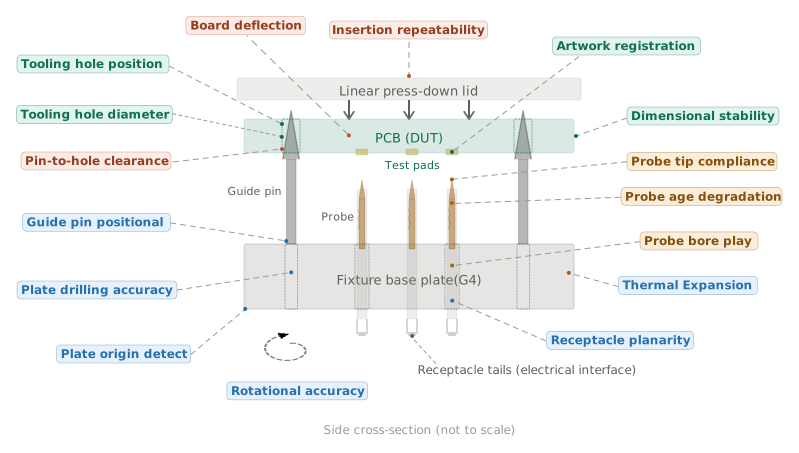
Before quantifying the tolerances, it helps to understand the physical assembly and where each source of variance lives. The diagram below shows a side cross-section of a typical functional test fixture with a press-down lid.
Starting from the bottom: the fixture base plate is a CNC-machined plate with precision-drilled holes for probe receptacles and press-fit guide pins. The probe receptacles are sleeves pressed into the plate, with tails extending below for electrical connection. Spring probes slide into the receptacles, with pointed tips extending upward through the plate surface. The PCB is lowered onto the guide pins — chamfered dowel pins that pass through tooling holes in the board to register its position. Finally, a linear press-down lid applies uniform downward force to fully seat the board and ensure consistent probe compression.
Every interface in this stack — pin to hole, probe to receptacle, artwork to drill pattern — introduces positional uncertainty. We group these into four categories by their physical source:
Tolerance Contributors & Assumptions#
We identify 16 individual contributors to test point positional accuracy, organized into three tiers based on when and how they’re determined. This tier structure is critical — it determines whether errors are correlated across probes on the same board, which fundamentally affects how they combine statistically.
Fixed per fixture#
These offsets are set once when the fixture is built and remain constant for every board tested in that fixture. If the CNC was slightly misaligned when it drilled the plate, every single test point inherits that error permanently.
Fixed per board lot#
These offsets are determined during PCB fabrication and are the same for every board from a given production panel. If the fab house’s artwork registration was shifted 0.05 mm (2 mils) on a panel, every board from that panel carries the same shift.
Random per insertion#
These vary from one board insertion to the next. Where the board settles within the guide pin clearance, how the probe tip deflects — these are the only contributors that behave as truly independent random variables on each test cycle.
The table below lists all contributors with their assumed tolerance values. These values are drawn from our fixture manufacturing data, IPC specifications, and probe manufacturer datasheets.
Table 1 — interactive. Edit any value and every figure and result in this analysis recalculates automatically. Hover any contributor name for a detailed description. Assumptions are grouped by tier and represent ±3σ tolerance limits.
| Contributor | Category | ± mm | ± mils |
|---|---|---|---|
| Fixed / fixture | |||
| Plate CNC drilling | Fixture | 0.4 | |
| Plate origin detect | Fixture | 5.0 | |
| Guide pin positional | Fixture | 3.9 | |
| Receptacle planarity | Fixture | 3.9 | |
| Rotational accuracy | Fixture | degrees | |
| Fixed / board lot | |||
| Tooling hole position | PCB fab | 2.0 | |
| Tooling hole diameter | PCB fab | 2.0 | |
| Artwork registration | PCB fab | 3.0 | |
| Dimensional stability | PCB fab | 1.0 | |
| Random / insertion | |||
| Pin-to-hole clearance | Registration | 2.0 | |
| Insertion repeatability | Registration | 3.9 | |
| Probe tip compliance | Probe | 3.9 | |
| Probe bore play | Probe | 0.5 | |
| Board deflection | Registration | 0.5 | |
| Thermal expansion | Fixture | 0.5 | |
| Probe age degradation | Probe | 3.9 | |
Linear Worst-Case Tolerance Analysis#
The most conservative approach to tolerance analysis simply adds every contributor’s maximum deviation. This assumes every tolerance is simultaneously at its worst, all pushing in the same direction — the “everything goes wrong at once” scenario.
The visualization below stacks each contributor’s tolerance as a block, building up to the total worst-case offset — block height is proportional to the tolerance value, and color marks its category. Hover any block for its exact figure. This diagram, and every visualization that follows, recomputes live from the editable assumptions in Table 1 above — change a value there to see the analysis respond.
The linear total means that in a theoretical worst case, the probe could land nearly a full millimeter from the pad center. This is a useful upper bound — it guarantees that the actual offset will never exceed this value — but it is almost certainly overly pessimistic. The probability that every contributor is simultaneously at its maximum, all in the same direction, is vanishingly small. This motivates a statistical approach.
Note: Rotational accuracy is excluded from both the linear and RSS totals because its contribution depends on board geometry — specifically, the distance from each test point to the guide pin axis. It is fully accounted for in the Monte Carlo and board-level yield analysis, where board length is an explicit parameter.
RSS Tolerance Stack-Up Analysis#
Root Sum of Squares (RSS) analysis takes advantage of the fact that each tolerance contributor is an independent random variable. Rather than assuming every tolerance maxes out simultaneously, RSS combines them statistically — and the result is dramatically smaller than the linear sum.
The RSS method computes the statistical total as:
This gives the ±3σ envelope — the range within which 99.73% of outcomes will fall, assuming each contributor is normally distributed and independent.
The geometric intuition#
RSS has an elegant geometric interpretation. Each tolerance contributor, when squared, becomes an area. The RSS total is the side length of a single square whose area equals the sum of all contributor areas. The treemap below makes this literal — every contributor’s squared tolerance (t²) is packed proportionally into one square.
The treemap immediately reveals where improvement efforts should focus. The largest blocks represent the contributors with the most influence on the statistical total. Conversely, the smallest blocks are visually insignificant, reflecting their negligible contribution to the overall variance budget.
Comparing the two approaches#
With both methods established, we can compare them directly. The visualization below uses the same colored blocks for both — on the left, stacked linearly by height (tolerance value); on the right, packed by area (tolerance squared) into the RSS result square. The dramatic size difference between the two tells the story at a glance.
The RSS result is roughly one-third of the linear worst-case. This compression ratio is typical for tolerance stack-ups with many contributors — the more independent variables involved, the more RSS diverges from worst-case, because the probability of all contributors simultaneously maxing out becomes astronomically small.
Both numbers have their place: the linear total is a guaranteed upper bound, while the RSS total represents the statistically expected ±3σ envelope. In practice, most fixture designers target the RSS value for design decisions, with the linear value serving as an absolute “never exceed” reference. But which one better predicts real-world probe contact performance? To answer that, we turn to simulation.
Monte Carlo PCB Test Simulation#
While RSS gives us the statistical envelope, Monte Carlo simulation lets us see what actually happens. We simulate hundreds of board insertions, each time randomly sampling every tolerance contributor, and plot where the probe actually lands relative to the pad center.
Three-tier correlation model#
Not all contributors are independent across probes on the same board. We model three tiers of correlation:
Fixed per fixture offsets (plate drilling, guide pin position, receptacle planarity, machining rotation) are sampled once per fixture and apply to every board tested. Fixed per board lot offsets (tooling hole position and diameter, artwork registration, dimensional stability) are sampled once per production lot. Only the random per insertion offsets (probe tip compliance, insertion repeatability, age degradation) vary independently on each test cycle.
This correlation structure means that when one probe is near the edge of its pad, neighboring probes likely are too — they share the same systematic offset. The scatter plot below shows six different fixture/board-lot combinations, each a different color, with probe hits sized to a real 0.05 mm probe tip and standard pad diameters drawn to scale.
The scatter pattern reveals several important characteristics. First, the cluster centers (crosses) are not at the origin — they’re shifted by the combined fixture and board-lot offsets. Some combinations land close to center (a lucky draw), while others drift significantly. Second, the random per-insertion spread around each cluster center is relatively tight compared to the cluster-to-cluster variation. This tells us that systematic offsets, not random scatter, dominate the real-world error budget.
The pad outlines, drawn to scale, provide an immediate visual test of contact reliability for each pad size. The reader can observe which pad diameters comfortably contain all hits across all combinations, and which begin to show probe contacts near or beyond the pad edge.
Board-Level Spring Probe Contact Yield#
Individual probe hit rates tell only part of the story. A test fixture must achieve contact on every probe simultaneously. If even one probe misses its pad, the board fails contact verification and must be retested.
The probability that all N probes make contact depends critically on the correlation structure. Because most of the error budget is shared across all probes on a board (fixture and lot offsets), the board-level yield doesn’t degrade as catastrophically with increasing probe count as a naive independent model would predict.
The chart below shows first-pass contact yield versus number of test points per board, for each pad size. Shaded bands show the 95% binomial confidence interval for the simulated yield.
The correlation effect is significant: the correlated three-tier model predicts substantially better yield than a naive independent model (pN) would suggest, because shared offsets mean “good boards are good everywhere.” However, the flip side is that when misses occur, they tend to cluster — a “bad” fixture/lot combination may miss several probes simultaneously.
About the confidence bands#
Because the yield at each probe count is computed from a finite simulation (2,000 boards), a different random run would produce a slightly different curve. The shaded bands quantify that sampling uncertainty. Each data point is essentially a pass/fail proportion — how many of the 2,000 boards achieved contact on all probes — so a binomial confidence interval is the natural fit. We use the Wald normal approximation:
where p̂ is the observed yield fraction and n = 2,000 boards. The 1.96 multiplier corresponds to 95% confidence. This approximation is reliable when the sample size is large and the proportion isn’t extremely close to 0 or 1 — both conditions hold here for the interesting cases. Where yield reaches exactly 100% (as with the 1.00 mm pad), the formula gives zero width because there’s no observed variation to measure — every simulated board passed.
Test Point Design Guidance#
The tolerance stack-up analysis reveals several practical insights for fixture design and test pad specification. Note that the specific thresholds below reflect our current tolerance assumptions — adjust the values in Table 1 to explore how these conclusions shift with different inputs.
The 0.80 mm rule-of-thumb is well-founded: our Monte Carlo simulation, calibrated with our fixture manufacturing data, confirms that 0.80 mm diameter test pads provide reliable contact across a wide range of fixture builds and board lots. Pads of 0.50 mm and smaller enter a regime where fixture/lot luck significantly affects contact yield.
Systematic offsets dominate the budget. The three-tier analysis shows that fixed offsets (per fixture and per board lot) contribute more to the total error budget than random per-insertion variation, so fixture build quality and PCB fabrication consistency have more impact on test reliability than operator technique or test cycle variation.
Within those systematic offsets, PCB fabrication is the largest category. With default tolerance values, artwork registration alone accounts for roughly a third of the RSS variance budget. Working with your board supplier to tighten artwork-to-drill registration delivers more improvement per dollar than almost any other intervention.
On the fixture side, plate origin detection is the single largest contributor. At ±0.127 mm (5.0 mils), the offset between locating and test-point drill patterns dominates the fixture-fixed tier. Improving the origin detection process — better datum registration, more precise plate alignment — offers the highest-leverage fixture-side improvement.
Correlation cuts both ways. Because most offsets are shared across all probes on a board, board-level yield doesn’t degrade as severely with probe count as a naive analysis would predict. But the same correlation means contact failures cluster: a bad combination misses multiple probes, while a good combination hits everything cleanly.
Finally, build quality decides whether any of these numbers hold. Every value in Table 1 assumes a precision-machined plate, production-grade spring probes, and a controlled CNC drilling process. A fixture built to looser tolerances — economy materials, less precise machining, worn tooling — carries larger values in several contributors, which shifts every yield curve in this analysis downward. When you evaluate a fixture, the question that matters is not the pad size alone but the actual plate-drilling and origin-detection tolerances of the build behind it.
Where to go next#
The analysis above is general. A few directions to take it further on your own project:
Pull test point coordinates and sizes straight from your Altium project to audit them against the pad-size guidance above.
A practical cost model for when a bed-of-nails fixture pays for itself versus manual board testing.
How an IoT startup scaled board testing from first prototypes through volume production.
Tolerance Contributor Reference#
This appendix documents each tolerance contributor in detail, including a physical description, the rationale for the assumed default value, and reference citations where applicable. These descriptions support the editable assumptions in Table 1.
The default tolerance values assume a production-level test bench: a G-10 (garolite) fixture plate, precision-ground guide pins, and high-quality spring probes from a reputable manufacturer. Fixtures built with lower-grade materials, looser machining tolerances, or economy probes will generally show larger variance in several categories — adjust Table 1 accordingly.
| Contributor | Description | Default ± | Assumptions & References |
|---|---|---|---|
| Fixed / fixture | |||
| FixturePlate CNC drilling | Positional accuracy of CNC-drilled probe receptacle and guide pin mounting holes in the fixture plate relative to nominal coordinates. Controlled by the fixture builder’s CNC equipment calibration and tooling condition. | 0.010 mm (0.4 mils) | CNC positional accuracy for fixture-grade drilling. High-quality fixture shops achieve ±0.01 mm (0.4 mils) or better. Ref: QA Technology, “Pointing Accuracy” (ANQ124-A); production fixture data. |
| FixturePlate origin detect | Offset between the locating drill pattern and the test-point drill pattern, caused by the origin detection process when the fixture plate is re-registered between drilling operations. | 0.127 mm (5.0 mils) | Measured from production fixtures. This is the single largest fixture-side contributor due to the mechanical re-registration between drill passes. Ref: Production fixture measurement data. |
| FixtureGuide pin positional | Deviation of the guide pin centerline from its nominal position after press-fitting into the fixture plate. Includes machined hole position tolerance plus any shift introduced during press-fit insertion. | 0.100 mm (3.9 mils) | Combined positional error of reamed hole plus press-fit shift. Ref: ASME B18.8.2 dowel pin tolerances; production fixture data. |
| FixtureReceptacle planarity | Angular tilt of the receptacle within its mounting hole, causing the probe to project at a slight angle rather than perfectly perpendicular to the plate surface. Set permanently during fixture assembly. | 0.100 mm (3.9 mils) | Estimated from fixture assembly variability. Effect scales with probe extension length above the plate. Ref: Production fixture data; engineering estimate. |
| FixtureRotational accuracy | Angular misalignment of the CNC drilling pattern on the fixture plate. Creates a positional error that scales with distance from the guide pin axis — test points far from the pins suffer more than those nearby. | 0.0255° (distance- dependent) | At 100 mm from pins: ~0.044 mm (1.7 mils). At 200 mm: ~0.089 mm (3.5 mils). Measured from CNC rotational registration accuracy. Ref: Production CNC measurement data. |
| Fixed / board lot | |||
| PCB fabTooling hole position | Positional accuracy of tooling (registration) holes drilled in the PCB relative to the board’s datum reference. Determined by the PCB fabricator’s drill registration process. | 0.051 mm (2.0 mils) | IPC-6012 Class 2 drill registration tolerance is ±0.075 mm (3.0 mils); many fabricators achieve ±0.025 mm (1.0 mils). We use ±0.051 mm (2.0 mils) as a mid-range value. Ref: IPC-6012 rev. F; Cadence, “Common PCB Tolerances for Manufacturing.” |
| PCB fabTooling hole diameter | Variation in the finished diameter of the PCB tooling holes, affecting the fit to fixture guide pins. Includes drill diameter tolerance and any plating buildup if holes are plated. | 0.050 mm (2.0 mils) | Standard NPTH drill diameter tolerance is ±0.05 mm (2.0 mils); PTH tolerance is ±0.08 mm (3.1 mils). Tooling holes are typically NPTH. Ref: IPC-6012; PCBSync, “PCB Drill Tolerance.” |
| PCB fabArtwork registration | Misalignment between the copper artwork pattern (and thus test pad locations) and the drilled hole pattern on the PCB. Typically the single largest contributor in the PCB fabrication category. | 0.076 mm (3.0 mils) | Standard image-to-drill registration tolerance is ±0.075 mm (3.0 mils) for Class 2 per IPC-6012. This drives annular ring sizing. Premium fabs can achieve ±0.050 mm (2.0 mils). Ref: IPC-2221C §5.4.2; IPC-6012. |
| PCB fabDimensional stability | Change in PCB overall dimensions due to moisture absorption, post-cure shrinkage, or material movement after fabrication. Affects global position of all features relative to tooling holes, especially on larger boards. | 0.025 mm (1.0 mils) | FR-4 in-plane dimensional stability is typically <0.05% per IPC-TM-650. On a 200 mm board, 0.05% yields 0.10 mm (3.9 mils) total; on smaller boards or localized areas, ±0.025 mm (1.0 mils) is reasonable. Ref: IPC-TM-650 2.4.39; IPC-4101. |
| Random / insertion | |||
| RegistrationPin-to-hole clearance | Maximum lateral shift allowed by the designed clearance between the fixture guide pin OD and the PCB tooling hole ID. The board can sit anywhere within this envelope on each insertion. | 0.051 mm (2.0 mils) | Typical slip-fit clearance for dowel-to-hole is 0.025–0.075 mm (1.0–3.0 mils) per side. This is a design parameter — tighter clearance means less shift but harder insertion. Ref: ASME B18.8.2 dowel pin tolerances; fixture design practice. |
| RegistrationInsertion repeatability | Variation in where the PCB actually settles within the clearance envelope from one insertion cycle to the next. Influenced by press-down lid engagement, operator technique, and gravity. | 0.100 mm (3.9 mils) | With a linear press-down lid, the board seats more consistently than gravity alone but doesn’t eliminate lateral shift. Ref: Production fixture data; QA Technology “Pointing Accuracy” discusses UUT registration. |
| ProbeProbe tip compliance | Lateral deflection of the spring-loaded plunger tip under contact force, including scatter pattern from plunger straightness and internal clearances. Measured as Total Indicator Reading (TIR) at the probe tip. | 0.100 mm (3.9 mils) | QA Technology publishes TIR data for each probe series. Typical average pointing accuracy (½ TIR) ranges from 0.025–0.100 mm (1.0–3.9 mils) depending on series and tip style. Ref: QA Technology, “Pointing Accuracy” (ANQ124-A) — 50-probe TIR test results by series. |
| ProbeProbe bore play | Lateral movement of the spring probe within the receptacle bore, allowing the probe body to shift or tilt within its socket. Distinct from probe tip compliance — this is movement of the entire probe assembly. | 0.013 mm (0.5 mils) | Precision receptacles have tight bore-to-probe clearance. Multi-press-ring sockets further constrain radial play. Ref: QA Technology, “Pointing Accuracy” — probe-to-socket concentricity and socket straightness as TIR contributors. |
| RegistrationBoard deflection | Lateral displacement of the test pad contact point caused by PCB bending under aggregate probe spring force. More significant on thin boards, large probe fields, and areas far from support points. | 0.013 mm (0.5 mils) | With guide pins providing board support and a press-down lid constraining Z-axis movement, lateral deflection at the contact point is small. Assumes a reasonably well-supported 1.6 mm FR-4 board. Ref: Engineering estimate; dependent on board thickness, span, and total probe force. |
| FixtureThermal expansion | Differential in-plane expansion between the PCB (FR-4) and the fixture plate (typically aluminum) due to temperature differences during testing. Worst case at board edges on large boards. | 0.013 mm (0.5 mils) | FR-4 in-plane CTE is 14–17 ppm/°C. For a 200 mm board with a 10°C delta from ambient, expansion is ~0.03 mm (1.2 mils). Assumes moderate board size with small thermal gradient during ICT. Ref: IPC-4101; FR-4 CTE per IPC-TM-650 2.4.41. |
| ProbeProbe age degradation | Increased probe tip wander and reduced spring force consistency as probes accumulate test cycles. Receptacle bore elongation and plunger wear contribute to increased positional scatter over time. | 0.100 mm (3.9 mils) | Modeled as a worst-case scenario representing probes approaching end-of-life. New probes would have significantly lower values. Ref: Production fixture data; engineering estimate. |